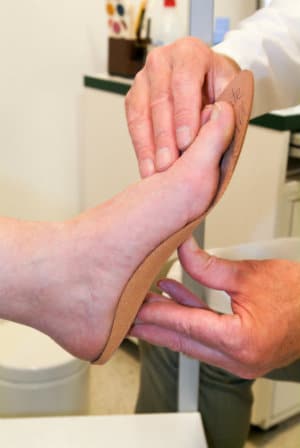
When it comes to the possible tools and techniques we have to help patients overcome painful conditions, perhaps the most versatile is the use of orthotic devices. Custom orthotics can be used to treat issues as diverse as bunions, cavus foot (high, rigid foot arches), hammertoe, metatarsalgia (forefoot pain), and plantar fasciitis.
Orthotic devices are also used to help pronation issues. Pronation is a natural process used by feet in every step they take. During the ground portion of a step, the foot rotates inwards from the heel strike all the way through the final push of the toes. This rotation isn’t intended to be particularly great—around fifteen percent is ideal—but it is important for ensuring proper distribution of the forces that come with walking and running.
Depending on an individual’s foot structure, he or she may either pronate too much (overpronation) or not enough (supination). As a general rule, overpronation is often linked to flatfoot and supination is connected to cavus foot. These pronation abnormalities lead to inequitable distribution of force loads, which means that certain areas of the foot face more pressure than they are intended. This can lead to a variety of issues.
The good news is that custom orthotics can help with both of these biomechanical irregularities!
Orthotic devices generally fall into one of two categories – functional and accommodative. When we discuss orthotics used to correct pronation issues, functional orthotics are the ones we use. These are often constructed from sturdy materials and able to restrict motion and account for structural abnormalities.
The primary reason that orthotics can be so effective at addressing pronation issues is the simple fact that they are customized for a patient’s unique feet and gait pattern.
Custom orthotics might be part of the treatment plan we create to address foot pain or restore functionality, but there are other options as well. Some patients benefit from switching to different shoe models or even using over-the-counter shoe inserts. Come see us here at our Berkeley, CA foot doctor office and we will provide the care you need. Call the office of Yuko Miyazaki, DPM at (510) 647-3744 to request an appointment or connect with us through our online contact form right now.






 Before we discuss
  An FSA is an account you might have wherein you make contributions out of every paycheck. The money goes into the account before it is taxed, so this can be a nice way to save money. During the year, if you need to pay for approved expenses, you can simply use the money saved up in your account. For many FSA plans, you can even withdraw the money you haven’t placed into the account yet (which is helpful if you get hurt in the middle of January!).